Spin the Stool: The Last Honest Seat at the American Table Is a Vinyl-Covered Swivel
Let me describe a place you probably haven't been in a while — or possibly ever, depending on your zip code and your relationship with laminate surfaces.
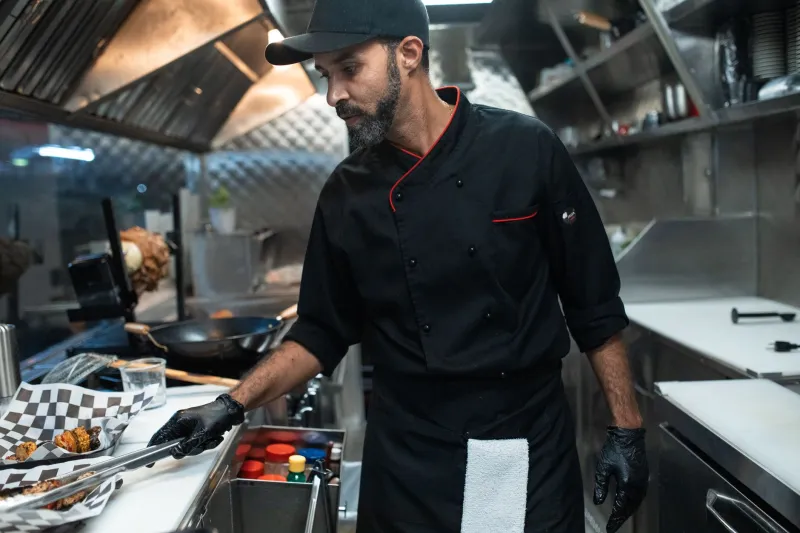
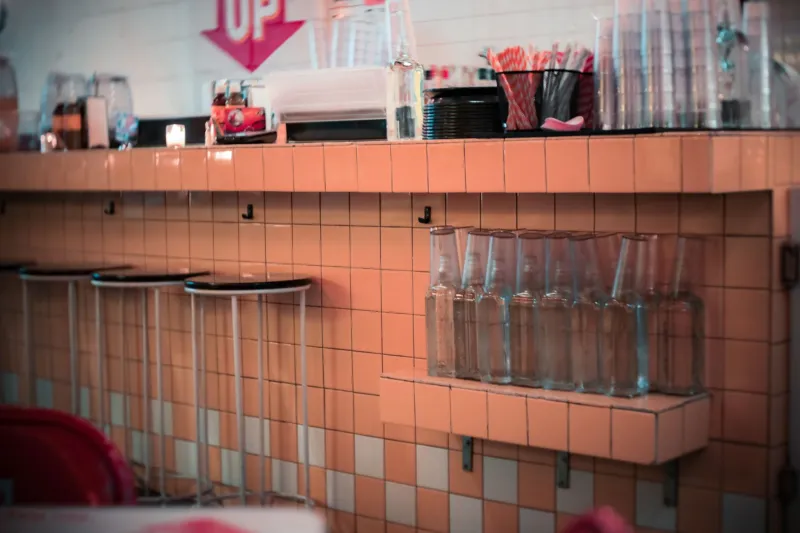
The counter runs maybe thirty feet. The stools are bolted to the floor and spin, though not as freely as they once did. There's a napkin dispenser that's been refilled ten thousand times, a pie case with one slice of coconut cream doing its lonely best, and a short-order cook behind the pass who has not, in the thirty-two years he's worked this line, once asked a customer how they're "doing today" before sliding a plate across the counter without breaking eye contact with the grill. The coffee arrives before you ask. The check arrives before you finish. Nobody is filming anything.
This is the American lunch counter. And it is, quietly and without much ceremony, dying.
What a Lunch Counter Actually Is (And Isn't)
Before we get sentimental, let's be precise. The lunch counter is not a diner, though it often lives inside one. It's not a bar, though the format rhymes. It is specifically the long, unbroken stretch of seating that puts you face-to-face with the kitchen — no wall, no pass-through window, no expediter in a headset. Just you, a Formica ledge, and a cook who can see exactly what you're doing with your food.
The format peaked somewhere between 1920 and 1960, when Woolworth's and its competitors ran lunch counters in nearly every mid-sized American city. These weren't destinations. They were infrastructure — the kind of place you stopped because you were hungry and it was there and the food was cheap and fast and nobody expected you to stay. The lunch counter was, in its own unglamorous way, a radical act of culinary egalitarianism: same seats, same menu, same cook, whether you were a bank manager or a bus driver.
(It's also worth noting that lunch counters became flashpoints during the Civil Rights Movement precisely because of that democratic promise — which some establishments were hypocritically refusing to honor. The Greensboro sit-ins happened at a Woolworth's lunch counter for a reason. The format carried moral weight it didn't always deserve but eventually had to reckon with.)
The Ones Still Standing
Finding a functioning lunch counter in 2024 requires some reconnaissance. They're out there, but they don't advertise. They don't need to.
At Zingerman's Roadhouse in Ann Arbor, Michigan, the counter seats are the best seats — close enough to the open kitchen that you can watch the short-order logic unfold in real time. But for a purer hit, drive forty minutes to any mid-Michigan small town and look for a place with a handwritten daily special on a whiteboard that was last wiped down sometime during a previous administration.
In Nashville, before the hot chicken industrial complex took over every available square foot of the city's culinary identity, places like Elliston Place Soda Shop were holding down the lunch counter format with meat-and-three plates and a clientele that's been eating there since before the word "Nashville" meant anything to people outside Tennessee. The counter at Elliston Place is not ironic. It is not a throwback concept. It just never stopped.
Head to Philadelphia and find the lunch counters tucked into the back of old luncheonette-style delis in neighborhoods that the food press hasn't colonized yet. Same story in Cleveland, Pittsburgh, and St. Louis — cities where the lunch counter survived partly because nobody from New York showed up to turn it into a pop-up.
Out west, Tucson has a handful of old-school counters attached to Mexican restaurants where the food is built for repetition and speed in the best possible way — the chile relleno has been the same chile relleno for forty years, and that is a feature, not a bug.
The Food Is Better Than It Has Any Right to Be
Here's the thing nobody tells you about lunch counter food: it's good. Not in a "rustic charm" way or a "humble simplicity" way that food writers use when they mean "not very good but culturally significant." Actually good.
The reason is repetition. A short-order cook who has made the same egg sandwich five hundred times this month has developed a muscle memory that no amount of culinary school training can replicate. The hash browns are perfect not because someone is trying to make perfect hash browns — they're perfect because imperfect hash browns would slow down the line. Quality is a byproduct of efficiency, which is a dynamic that basically no other restaurant format can claim.
The coffee is another matter. Lunch counter coffee is what it is: hot, abundant, and refilled without being asked. Whether it's good depends entirely on your definition of good. If your definition involves single-origin pour-overs, you are in the wrong seat. If your definition involves a cup that does its job without requiring your participation, you are exactly where you belong.
Why They're Disappearing (And Why That's Actually a Problem)
The math is brutal. Lunch counters require a specific kind of labor — fast, experienced, unflappable — that's increasingly hard to find and expensive to keep. The real estate they occupy, often on main streets in towns that are gentrifying or dying (there's rarely a middle), gets converted into something with higher margins or torn down entirely. The owners are frequently in their seventies. The succession plan is frequently nonexistent.
What replaces them is almost always worse, not in a curmudgeonly way but in a measurable, structural way. The fast-casual restaurant that opens in a lunch counter's former space is slower, more expensive, and less personal. The app-based delivery option that fills the gap removes the one thing that made the lunch counter irreplaceable: the counter itself. The seat. The proximity. The fact that you are sitting three feet from a human being making your food and there is nowhere to hide and no performance being staged for your benefit.
Restaurant culture in America has spent the last twenty years moving aggressively toward experience — toward the curated, the theatrical, the photogenic. The lunch counter is the opposite of all of that. It is anti-experience in the best possible sense: it exists to feed you, efficiently and without fuss, in the company of strangers who are also just trying to eat lunch.
Go Find One Before You Can't
I'm not going to tell you that eating at a lunch counter will change your life. That's not the point. The point is that it will remind you what a restaurant is actually for — which is a thing we seem to need reminding of more often than we'd like to admit.
So find one. They're in your state, probably in a town you've driven through without stopping. Sit down. Order the special. Don't photograph it. Let the cook do his thing. Spin the stool a little when nobody's looking.
And tip well. The person behind that counter has been doing this longer than most restaurants have been open, and they'll be doing it long after those restaurants are gone — if we're lucky.