Parked and Dangerous: The Rogue Chefs Ditching White Tablecloths for Truck Windows
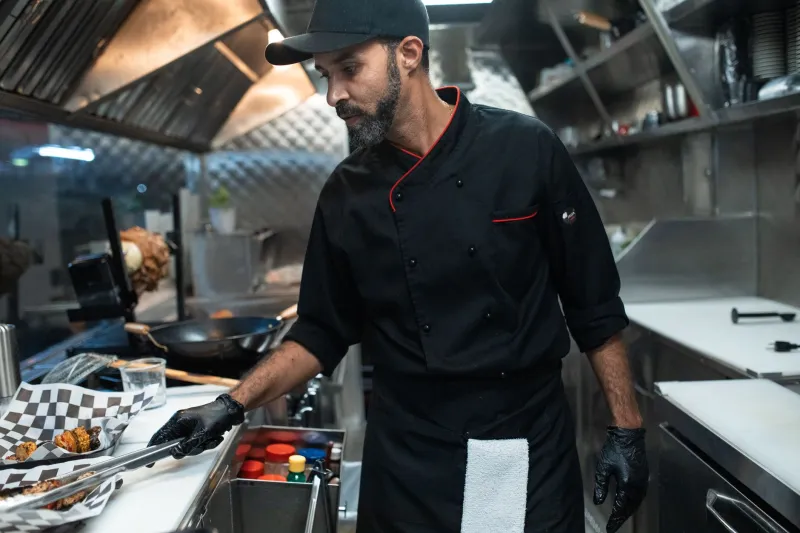
There's a food truck parked outside a self-storage facility in East Nashville every Thursday. The menu is a laminated half-sheet. The payment system is a Square reader duct-taped to the counter. The line, on a good week, wraps around a dumpster. And the guy behind the flat-top — the one in the faded Carhartt hat who's been up since 4 a.m. breaking down heritage pork shoulders — spent eleven years working under two of the most decorated chefs in New York City.
He asked us not to use his name. Which, honestly, is the most on-brand thing that's happened to us in years.
The Great Escape from Fine Dining
Call it burnout. Call it a philosophical reckoning. Call it what happens when you've spent a decade plating microgreens with tweezers and you finally snap. Whatever the origin story, the phenomenon is real and it is spreading: classically trained, deeply credentialed chefs are abandoning the white-tablecloth world in numbers that would make a restaurant group's HR department weep, and they are showing up — deliberately, almost defiantly — in the most unglamorous formats imaginable.
Food trucks. Parking lot pop-ups. Lunch-only operations run out of converted horse trailers. The disguise, in every case, is the point.
"I didn't want a Yelp page," said one chef we spoke with — a former sous chef at a three-Michelin-star restaurant in San Francisco who now runs a Filipino-Cajun fusion cart in the Freret Street corridor of New Orleans. "I didn't want a sommelier. I didn't want a PR person. I wanted to hand someone a container of food and watch their face."
That last part — watching their face — came up in almost every conversation we had for this story. It turns out that one of the things fine dining accidentally engineers out of the experience is the immediate, unfiltered, unmediated human reaction to food. When a table of four is processing an eight-course tasting menu in hushed tones while a server explains the provenance of the salt, the feedback loop is long and complicated. When someone takes a bite of your smoked brisket taco standing next to a parking meter and says, out loud, to no one in particular, "oh my god" — that's a different kind of data.
The $9 Taco Is Not an Accident
Let's be clear about something: the pricing at these operations is not charity. It's a statement.
Chefs who have spent careers working in restaurants where a single pasta course costs $40 are, in many cases, deliberately pricing their food at a level that removes any barrier to entry. The $9 taco, the $7 bowl, the $12 sandwich that takes two hands and a full paper towel — these aren't concessions to the format. They're the thesis.
"Fine dining convinced itself that price was a proxy for quality," said a chef in Austin who trained at a Relais & Châteaux property in France and now runs a weekend-only smash burger truck near the Domain. "I wanted to disprove that in the most direct way possible. Every Saturday, I do."
What you're actually getting at these trucks, if you know where to look, is technique that most restaurant kitchens would charge three times as much to apply. Stocks made from scratch. Proteins sourced with the same obsessive specificity that used to go into a $65 entrée. House-made condiments. Fermented things that took weeks. All of it deployed in the service of something you eat off a piece of butcher paper with your hands.
The Regulars Who Had No Idea
Perhaps the most delightful subplot of this whole movement is the regulars — the people who found these trucks not through a food publication or an Instagram algorithm, but through proximity, luck, and hunger.
In Chicago, a woman named Darlene has been getting lunch from the same Korean-Mexican truck near her office in Pilsen for two years. She found out last spring, via an offhand comment from a coworker, that the owner had been a finalist for a James Beard Award in the Outstanding Chef category. Her response, as she relayed it to us: "I mean, I knew it was good. I didn't know it was that good."
This gap — between the food's actual pedigree and the customer's awareness of it — is, depending on who you ask, either a beautiful accident or a carefully maintained fiction. Several chefs we spoke with admitted to actively discouraging press coverage, declining to participate in food festivals, and maintaining social media profiles so sparse they border on performance art. One chef in Denver has a truck Instagram account with 340 followers and posts exclusively blurry photos of his mise en place. He sells out by noon every day.
Where to Find Them (If You Know How to Look)
The bad news: there's no Michelin guide for parking lots. The good news: there are patterns.
Farmers markets in mid-sized cities — think Chattanooga, Boise, Richmond, Tucson — have become unlikely hotbeds for this kind of operation. The overhead is low, the clientele is self-selecting, and the format rewards quality over volume. If you're at a Saturday market and you see a truck with a short, weird, specific menu and a line that's disproportionate to its signage, start asking questions.
Neighborhood Facebook groups and Nextdoor threads, for all their chaos, are genuinely useful here. The phrase "you have to try this truck" shows up in these spaces with a frequency that food media has mostly failed to track. Local Reddit communities — particularly the r/[CityName]Food subreddits — have become informal clearinghouses for exactly this kind of discovery.
And then there's the oldest method: talking to cooks. Line cooks, prep cooks, the people who work in restaurant kitchens and eat lunch somewhere that isn't their own employer. Ask a cook in any city where they eat on their day off. The answer is almost never a restaurant.
The Disguise Is Doing Real Work
Here's the thing about a food truck run by a chef who doesn't want you to know who they are: the anonymity isn't just personal preference. It's a functional part of what makes the food taste the way it does.
When there's no reputation to protect — or rather, when the reputation is entirely local, entirely word-of-mouth, entirely built on the thing itself — the cooking changes. There's no menu designed to justify a price point. There's no dish kept on the menu because a critic once liked it. There's no pressure to be consistent in the way a brand has to be consistent. There's just: what do I want to cook today, what's good right now, what will make the person at the window make that face?
The disguise, in other words, is not camouflage. It's liberation.
Somewhere in a parking lot near you, someone with very serious knife skills is making something extraordinary and charging you less than a cocktail at the place down the street. You probably won't know who they are. You probably don't need to.
Just get in line.