Tuna, Two Ways: I Spent $412 at Dinner and $12 at Lunch in the Same City. Here's What Actually Tasted Better.
Tuna, Two Ways: I Spent $412 at Dinner and $12 at Lunch in the Same City. Here's What Actually Tasted Better.
Let me be upfront about something: I went into this with a bias, and it was not the bias you'd expect. I wanted the expensive place to win. I wanted to sit down at that hushed, candlelit counter, hand over my credit card with the quiet dignity of someone who has their life together, and be transported. I wanted the $400 omakase to justify itself so thoroughly that I'd feel slightly embarrassed for even making the comparison.
It did not cooperate.
The Setup
The city doesn't matter — pick any mid-to-large American metro with a serious food scene and you'll find this exact tension playing out on repeat. On one end: a celebrated omakase restaurant, the kind with a three-month waitlist, a no-photography policy that is enforced with the energy of a Swiss border agent, and a tasting menu built around bluefin tuna sourced from a single prefecture in Japan. On the other end, about four miles away: a Japanese-owned neighborhood spot with eight counter seats, a laminated menu, a hand-lettered sign advertising the day's fish, and a $12 tuna bowl that regulars have been ordering since the Clinton administration.
Same ingredient. Same city. Same day — lunch at the counter, dinner at the temple. One reporter, one stomach, and a growing suspicion that American fine dining has become, at least in part, a very expensive performance of seriousness.
Lunch: The Counter
The neighborhood spot opens at 11:30. By 11:25, there are five people waiting outside, none of whom appear to be doing it for content. This is a good sign.
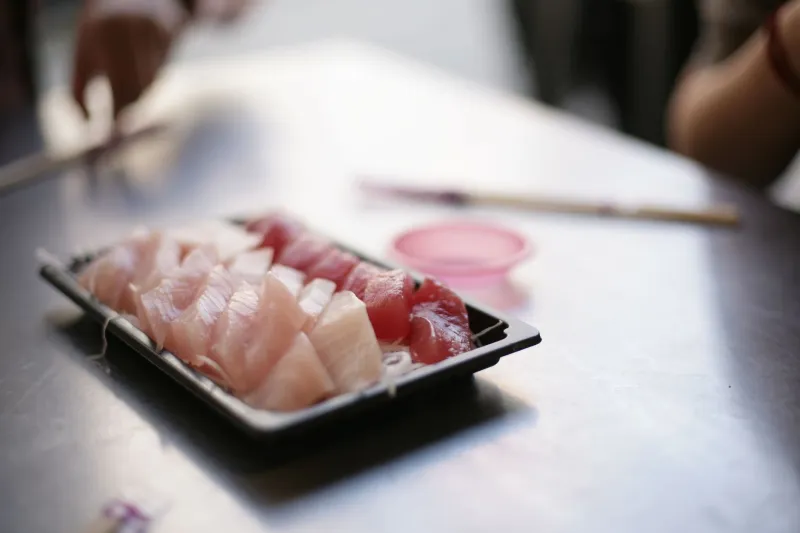
The tuna bowl arrives in about four minutes. It is not plated. It is built — a lacquered wooden bowl, a mound of rice that has been seasoned with the confidence of someone who has done this ten thousand times, and slices of tuna draped over the top with the casual elegance of someone who doesn't need to try. There's a smear of wasabi that was clearly grated fresh, a few drops of soy, some shiso, a scattering of sesame. That's it.
The first bite is one of those moments where your brain briefly disconnects from your body. The fish is cold, clean, and almost sweet. The rice is warm and has a slight vinegar tang that cuts through the fat of the tuna in a way that feels less like recipe and more like physics. The owner — who is also the chef, also the cashier, also the person refilling your water — nods at you from behind the counter when you look up. He has seen this face before.
Total bill: $12.50, including tax. I left a $7 tip and felt like I was getting away with something.
Dinner: The Temple
The omakase begins with a briefing. Not a menu — a briefing. The chef, a soft-spoken man with the focused energy of someone defusing something, explains the sourcing of the evening's bluefin in the kind of detail that makes you feel both educated and slightly interrogated. The room holds twelve people. Everyone is speaking in the murmured tones you'd use in a library or a very fancy funeral.
The tuna courses — there are four of them across the meal — are, in fairness, extraordinary. The otoro melts in a way that the word 'melts' was invented to describe. A single piece of chutoro, brushed with a reduction I couldn't fully identify, is genuinely one of the most technically accomplished bites I've eaten in recent memory. The knife work is borderline theatrical. The rice, formed by hand and served at a temperature the chef has clearly obsessed over, is perfect.
And yet.
Something is missing, and it takes me most of the meal to name it. The food is flawless in the way that a museum piece is flawless — you can admire it completely and still feel a pane of glass between you and it. Every course arrives with context, with provenance, with a small verbal essay about intention. By the seventh course, I realize I've been nodding along like a student who doesn't want to disappoint a professor. The anxiety of being here — of not reaching for my phone, of holding my chopsticks correctly, of responding to each explanation with appropriate reverence — is doing quiet battle with the pleasure of eating.
Total bill: $412, including a beverage pairing I felt pressured into by the architecture of the room.
The Verdict Nobody Wants to Say Out Loud
Here's the uncomfortable math: the $12 bowl made me happier. Not marginally. Significantly. I thought about it on the way to the omakase. I thought about it during the omakase. I am thinking about it now.
This is not an argument that the expensive restaurant was bad — it wasn't, not even close. The technical execution was in a different stratosphere. But somewhere between the sourcing monologue and the fourth course and the moment I realized I was scared to chew loudly, the meal had become less about eating and more about demonstrating that I was the kind of person who could eat there correctly.
What the $400 omakase is selling, at least in part, is not food. It's a performance of taste, a ritual of belonging, a very beautiful evening in a room full of people who have agreed to take fish extremely seriously together. There is real value in that. I'm not here to pretend otherwise. But it is a different value than what the $12 counter is selling, and we should probably stop pretending they're competing in the same category.
What We're Actually Paying For
The counter is selling the food, almost exclusively. The omakase is selling the food plus the story, the room, the choreography, the exclusivity, the status, and the very specific thrill of having secured a reservation that most people couldn't. Break it down per bite and the delta is enormous — but if you're being honest about what you're buying, the math starts to make a different kind of sense.
The problem is that American fine dining has gotten very good at conflating these two things, at making the theater feel inseparable from the taste, at training diners to experience the price as part of the flavor. When you've paid $400, the food tastes like it should be worth $400. That's not cynicism — it's psychology, and it's working on most of us most of the time.
The $12 counter has no such leverage. It just has to be good. And on a Tuesday in November, with no reservation and no briefing and no anxiety about my chopstick form, it was better.
I'll be back at the counter next week. The omakase, I'll remember fondly, the way you remember a very impressive first date that didn't quite become a second one.